Fabric guide
Our advice to choose, wear and make every piece last.
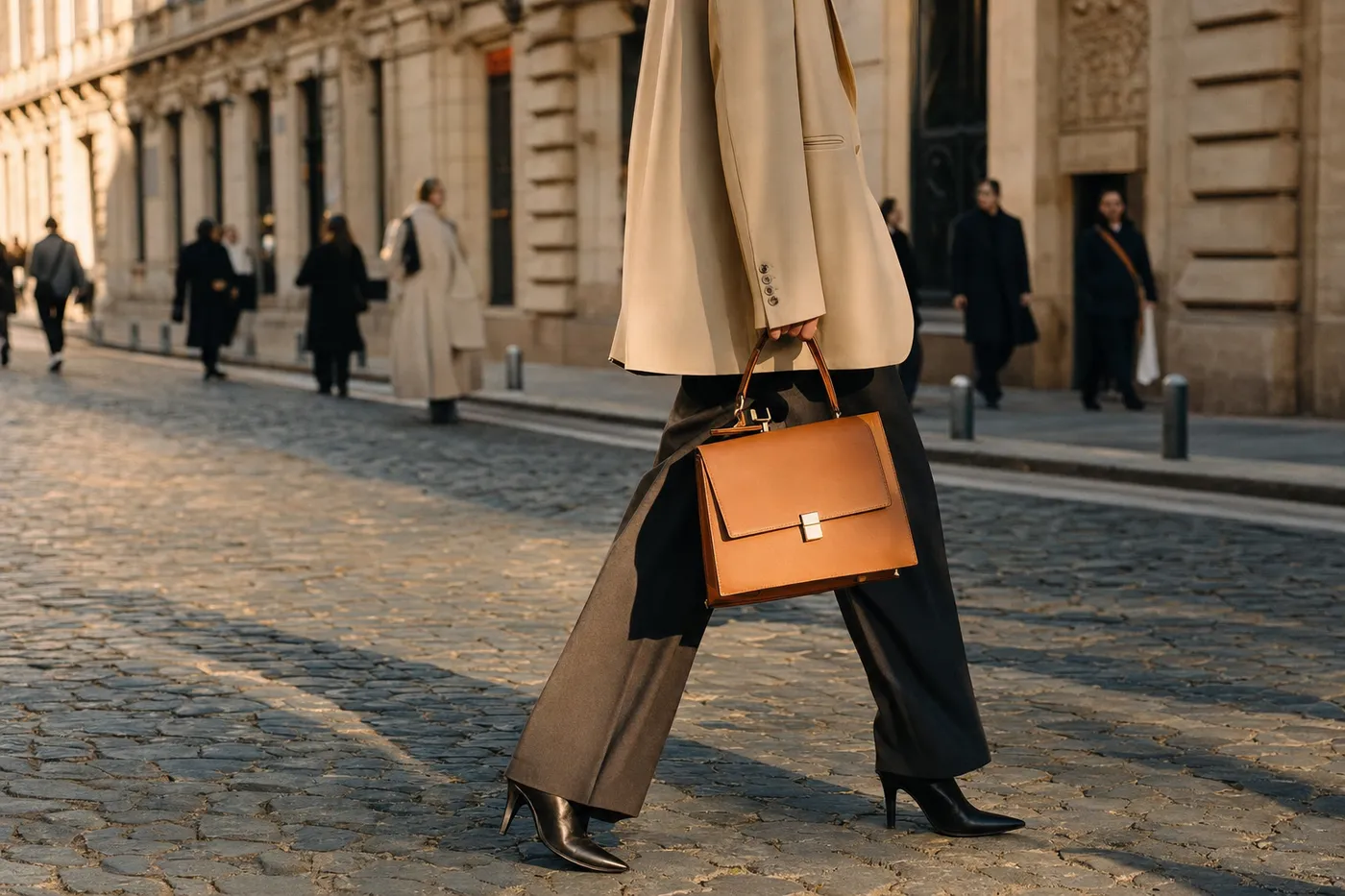
This week’s looks, decoded
Proportions, layering, accessories: four silhouettes spotted and what makes them work.
Fashion-week street style is a useful observation deck — provided you watch for what recurs rather than what stands out. The streets of Paris, Milan, London and New York agreed this winter on four crisp silhouettes — the ones that come through on photos without the central piece needing to be recognisable. Here are the four trends that took hold, with no street names and no signatures cited.
Silhouette 1 — Long coat, flat shoes
The most-spotted combo was a generous coat below the knee, worn with a flat — loafer, derby or low boot. The proportion works because the length of the coat lengthens the silhouette while the flat stabilises it. Seen across nearly every capital, in neutral colours: cream, brown, khaki, black.
Silhouette 2 — Relaxed tailoring + denim
Oversized blazer in wool or a linen blend, raw-hem straight jean, white T-shirt underneath. It's the end-of-show formula — the one that shows up in the streets as crowds spill out of venues. The shared detail: the blazer is slightly too big for the wearer, and that's intentional. A structured day bag finishes the outfit.
Silhouette 3 — Maxi dress + knit
A long fluid dress (linen, silk or viscose) with a fine knit pulled over the top. The dress peeks below the knit, the look creates two lengths. Seen in soft tones or contrasted (cream dress + black knit, green dress + beige knit). A flat boot or a discreet trainer at the foot.
Silhouette 4 — Tonal head-to-toe
A single colour from head to toe, in close shades — beige on beige, grey on grey, brown on brown. The hardest silhouette to wear without looking flat, but also the most elegant when it works. The key: vary fabrics (wool + leather + linen) so light catches them differently.
The accessory thread
- The structured day bag, medium size, in natural leather — seen in most photos.
- Discreet sunglasses, square or oval frames, acetate.
- A scarf knotted loosely at the neck or as a belt — a recurring detail.
- Fine gold jewellery (small earrings, choker) over silver.
- Flat shoes — barely any heels. The afternoon stiletto is over.
What these four silhouettes share: none requires a statement piece. They're combinations of elements already present in a thoughtful wardrobe, simply assembled in the right proportions. That's the main lesson from this season's street style — trends pass, proportions stay.
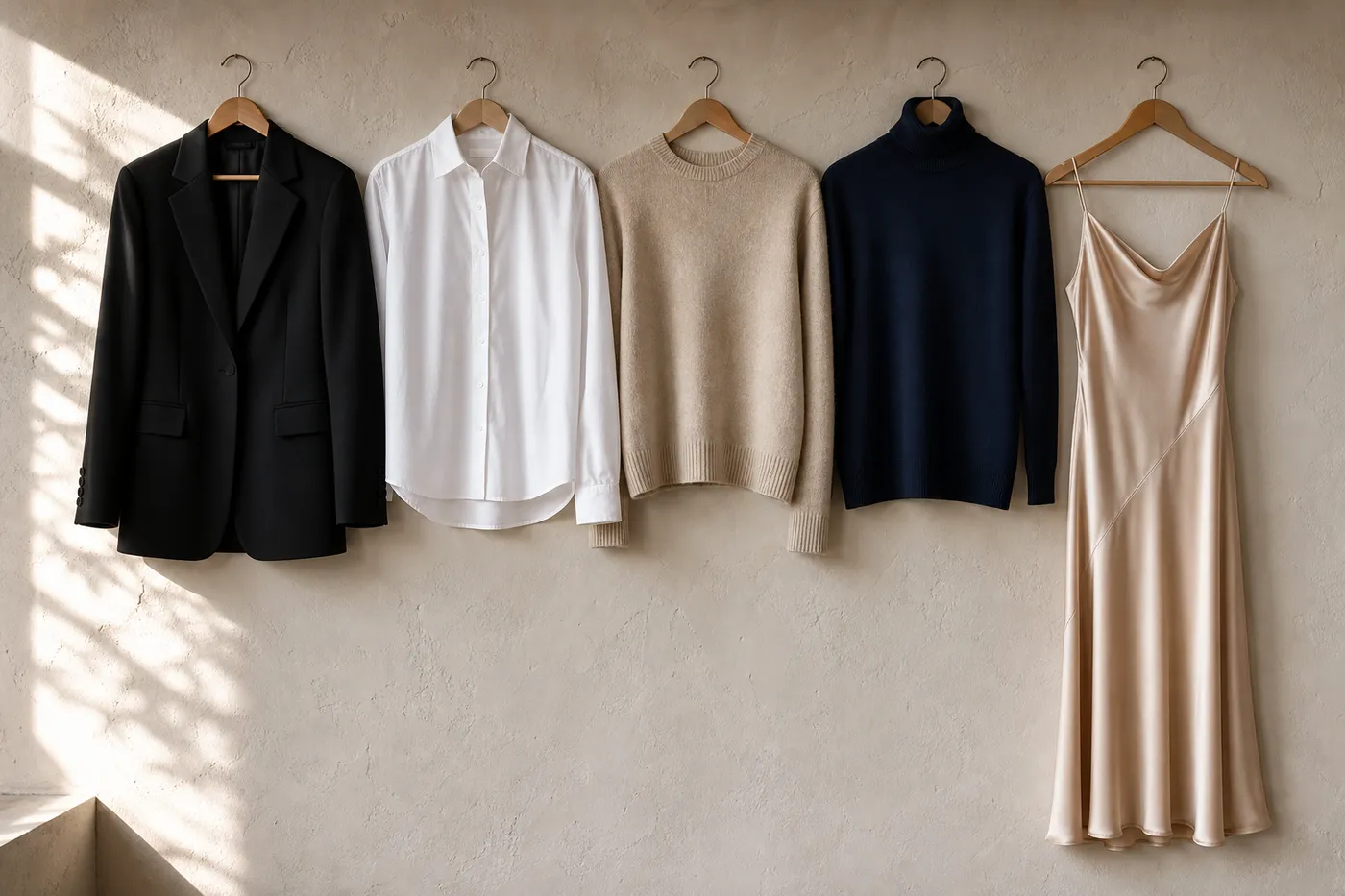
Thirty pieces, no hesitation in the morning
The capsule method applied to a real closet: what to keep, what to complete, what to let go.
The capsule wardrobe idea is simple: thirty pieces that combine with one another, chosen to work together rather than separately. In practice, it's a shift in buying logic — instead of adding, you replace. Here's the method that actually works, with the usual pitfalls flagged.
Step 1 — Set three base colours
An efficient capsule rests on three dominant neutrals. The classic trio: black, beige and white. The warmer trio: navy, cream and brown. The softer trio: pearl grey, white and taupe. Choosing one trio and sticking to it guarantees that everything mixes effortlessly. A single accent colour (deep red, forest green, midnight blue) can show up on three or four pieces — no more.
Step 2 — The 5/5/5 rule
Across thirty pieces, plan for roughly five basic tops (T-shirts, camisoles, white shirts), five knits and sweaters, five bottoms (jeans, trousers, skirts), five tailored pieces (blazer, coat, sweater dress), five evening or occasion pieces, and five structuring accessories (belt, bag, scarf, statement jewellery, pair of character shoes). This split covers the working week, the weekend, travel and going out without overlap.
Step 3 — Test before replacing
Before buying a piece for the capsule, ask the question: does it combine with at least five other pieces already in the wardrobe? If the answer is no, it's a love-at-first-sight buy, not a capsule investment. The pieces that last are the ones that pass this filter — and that get worn at least once a week for three months.
What to leave out
- Bright colours that only pair with one neutral.
- Cuts heavily marked by a season (loud prints or dramatic volumes).
- High-maintenance fabrics if the piece is meant to rotate often.
- Duplicates: two black knits that are too similar are one piece too many.
A successful capsule never feels frozen. It refreshes itself in small steps — a new white shirt every year, a new pair of shoes every two years. Day to day, the feeling is a light wardrobe, where everything works, and where nothing hangs unused out of fatigue.
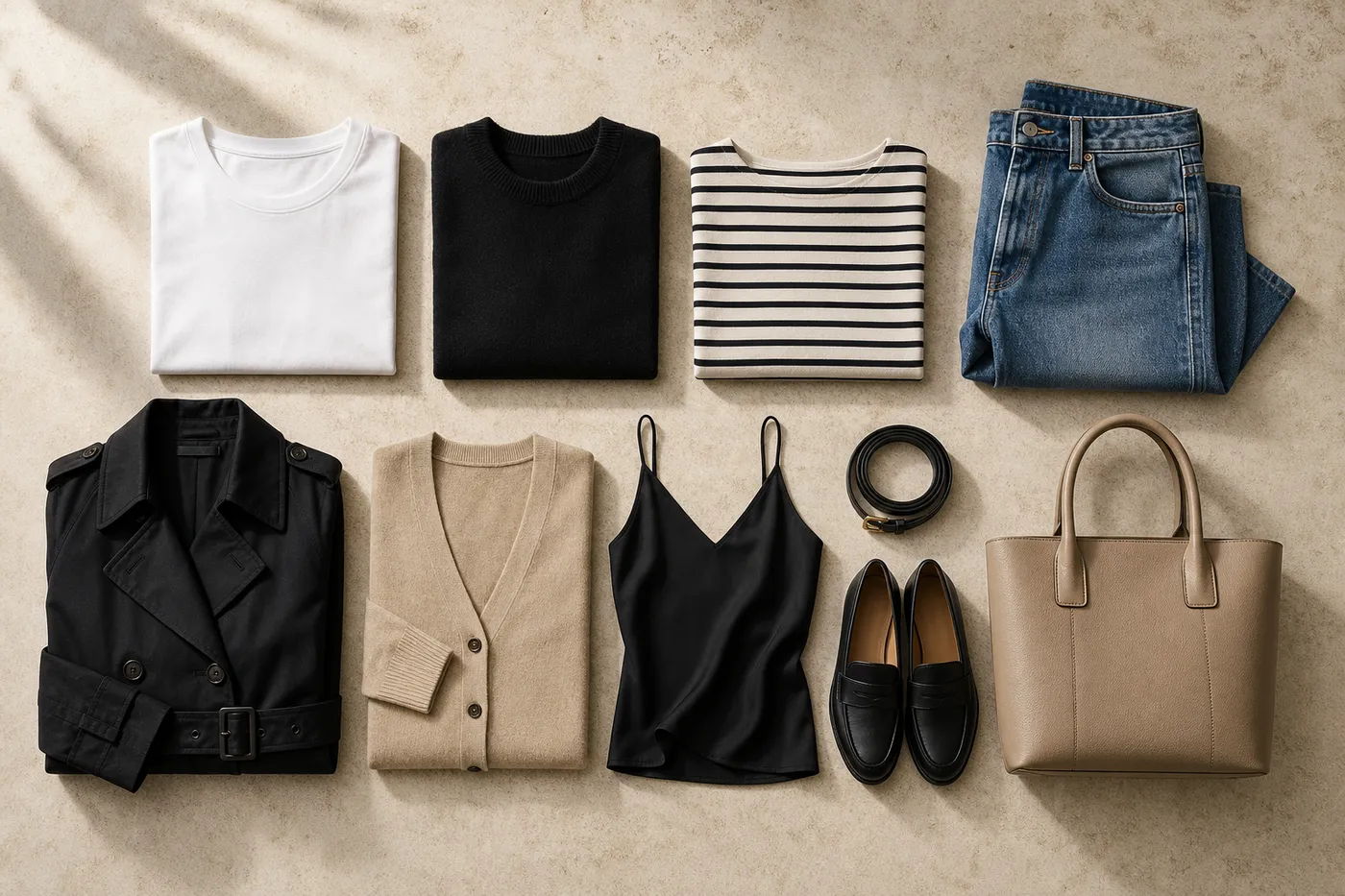
The ten pieces that hold a wardrobe together
White shirt, blazer, straight jeans, fine knit: the foundations that never date, and how to choose them.
Just ten pieces. The ones that remain when you remove trends, impulse buys and occasion-only clothing. None are decorative — all are genuinely useful, all carry across seasons. Here's the list, with what actually matters when choosing each.
1. The white cotton shirt
Choose poplin or a crisp dry cotton. Slightly tailored at the bust, sleeves that reach the wrist, a collar that holds its shape. The white shirt pairs with absolutely everything — it's the piece that pays back the most per square metre of fabric.
2. The straight-leg raw denim
Straight cut, ankle-length hem, mid- or high-rise depending on body shape. Raw denim shapes itself to the body within a few weeks and patinas elegantly. Avoid heavy washes — they date jeans faster than you'd think.
3. The thick cotton white T-shirt
A heavy cotton (180-220 g/m2) that doesn't show through and keeps shape after washing. Slightly oversized, clean round neck. The white T-shirt gets replaced every twelve months at the most — it's the piece that ages worst.
4. The cashmere knit (crew or v-neck)
A 2-ply cashmere in beige, pearl grey or black. Avoid very pale tones that pill quickly. Hand-wash, dry flat, store folded. A good cashmere lasts ten years if you treat it like a coat, not like a T-shirt.
5. The fluid black dress
Mid-length, short or three-quarter sleeves, simple neckline. The black dress that works is the one you can wear to the office on Thursday and to dinner on Saturday without changing the jewellery. One piece, two registers.
6. The beige trench
Classic cut, length below the knee, tied belt rather than buckled. The trench is the jacket that saves the rainy days of April and October. The inner lining should be removable if possible — same piece, longer in-season life.
7. The black tailored blazer
A blazer in cool wool, full inner lining, two buttons. Dressy enough for a formal meeting, soft enough to wear over a pair of jeans. It's the piece that makes serious-looking an outfit that isn't necessarily so.
8. The fluid tailored trouser
Straight or slightly flared cut, high waist, length that covers the heel. Cool wool or a viscose blend for the drape. The tailored trouser is the full alternative to jeans on the days when you need a little more than that.
9. The leather flats (loafers or ballerinas)
A quality flat shoe, in smooth leather, with a leather or thin rubber sole. Pairs equally with jeans and a skirt. Investing in a good pair changes the silhouette more than buying a tenth pair of trainers.
10. The structured leather day bag
A daytime bag, medium size, short handles, in good-quality grained or smooth leather. Camel, black or cognac. Avoid shiny hardware which dates — favour discreet finishes (simple buckle, plain clasp).
These ten pieces don't form a complete wardrobe — they form its backbone. Everything else attaches itself: a colourful knit, a print, one trend piece per season. But these ten are the ones you replace rather than the ones you remove.